

From Quiet Trash Trucks to a Cleaner Transportation Future
Eric Pollard’s work connecting Oklahoma communities with alternative fuels and transportation technology earns national recognition.
The City of Norman, for example, received grant funding through ACOG to help add compressed natural gas, or CNG, vehicles to its fleet. Meanwhile, eight additional ACOG member cities and counties have deployed alternative fuels, hybrid vehicles and electric vehicles.
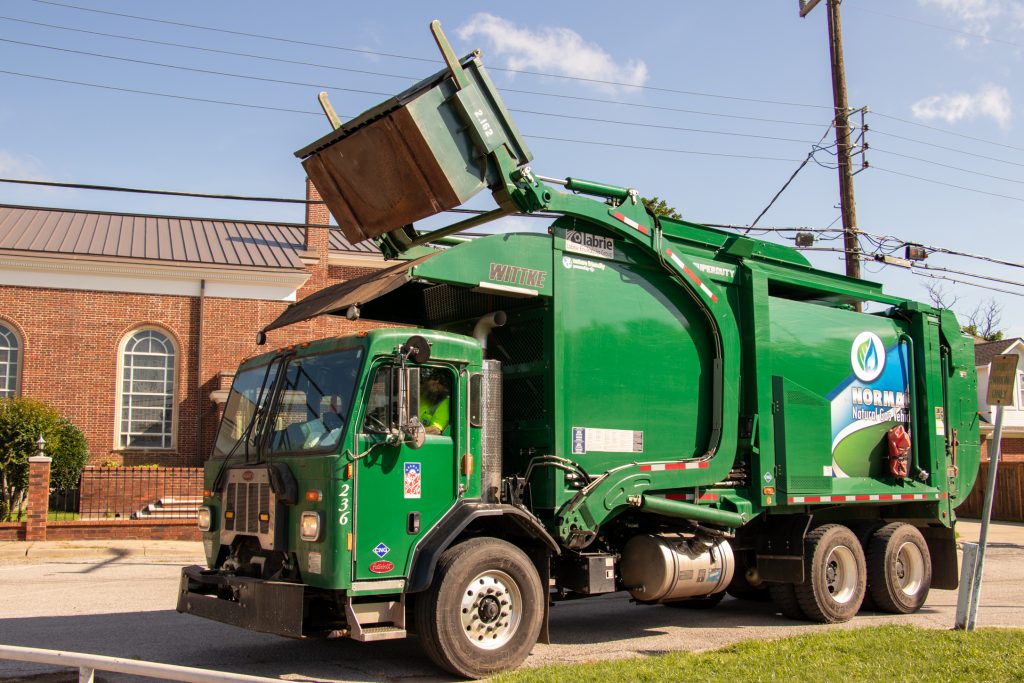
A City of Norman compressed natural gas sanitation truck services a container in Norman. Photo courtesy of the City of Norman.
“Instead of hearing a big diesel trash truck coming down the street, they may not hear it because it’s running on CNG,” Pollard said. “They can’t run their trash bin out to the curb at the last minute like they did in the past.”
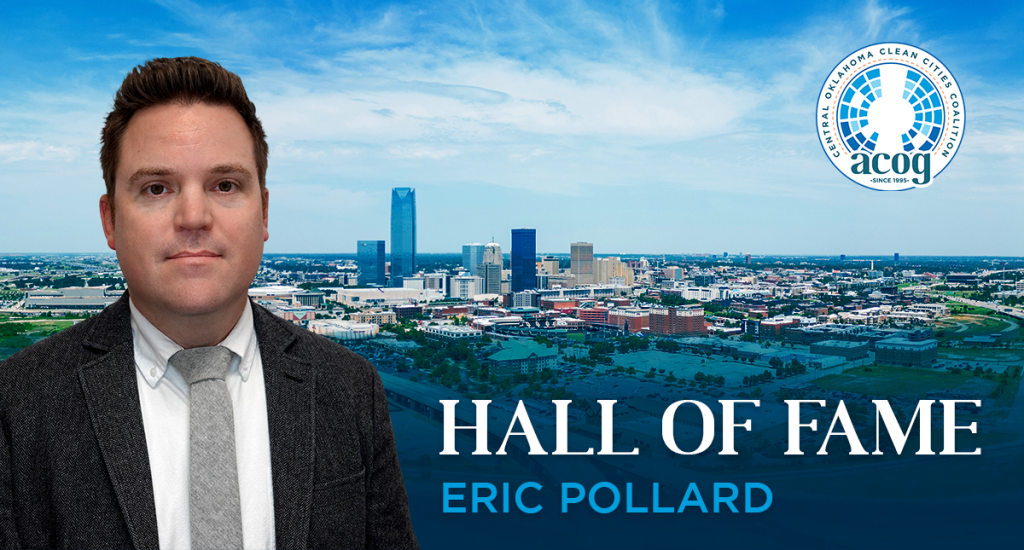
Pollard was inducted into the U.S. Department of Energy’s Clean Cities and Communities Hall of Fame on Sept. 3 during the organization’s Annual Training Workshop in Kansas City, Missouri. Pollard has led the Central Oklahoma Clean Cities Coalition since joining ACOG in December 2014.
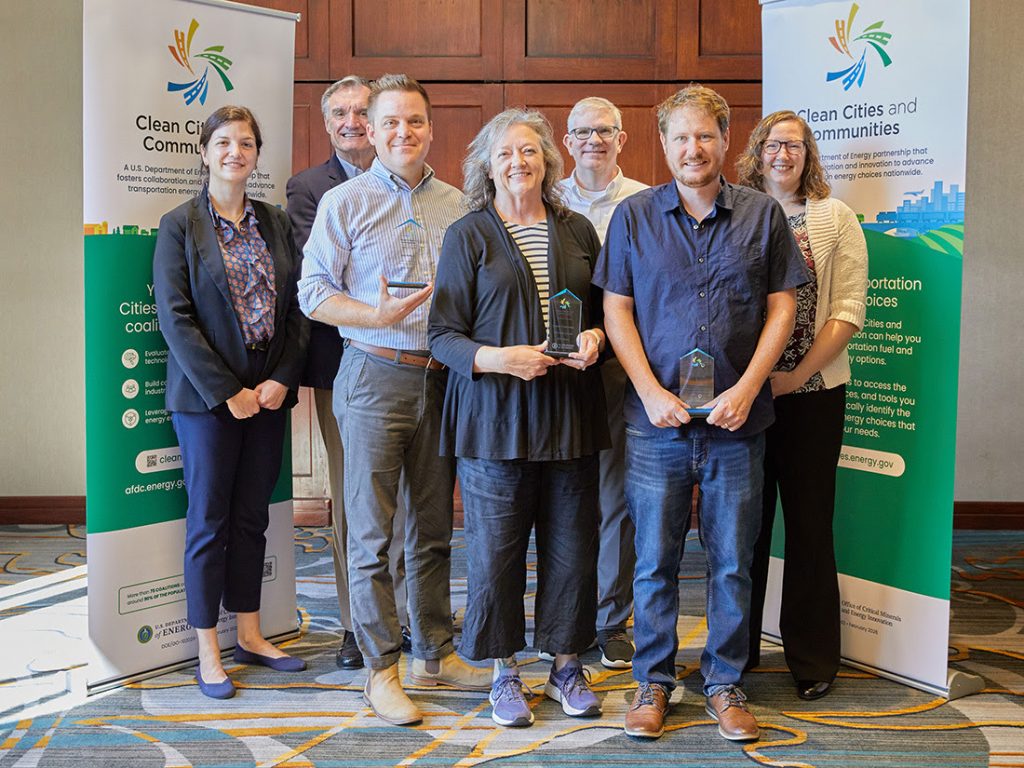
Eric Pollard (pictured 3rd from left) poses with other Clean Cities and Communities Hall of Fame inductees Sept. 3 in Kansas City, Missouri.
“We are honored to induct Eric Pollard into the Clean Cities and Communities Hall of Fame for his remarkable leadership and commitment to the advancement of transportation technologies throughout Oklahoma,” said Mark Smith, Technology Integration Program manager for the Department of Energy’s Vehicle Technologies Office.
The shift to CNG and other alternative fuel vehicles can provide another benefit for communities: lower and more predictable fuel costs.
“Right now, diesel is over $6,” Pollard said. “Cities and businesses that have made those investments are seeing exponentially larger savings than they may have expected when they first set out to do it.”
Pollard’s work involves more than CNG-powered trash trucks. He helps connect government agencies, utilities, businesses, universities and local fleets with information and resources to help them evaluate alternative fuels and transportation technologies.
“ACOG is a convener,” Pollard said. “With the support of our cities and counties, we’re able to reach out to the private sector and the public and bring everybody to the table to look at specific problems, issues or opportunities.”
EMBARK has worked with ACOG to secure funding for alternative fuel buses and supporting infrastructure. These long-term investments can produce more predictable fuel costs, improve air quality and reduce expenses for local governments and taxpayers.
Pollard’s work has been part of a long-term effort to expand alternative-fuel transportation across Oklahoma. He has brought together local governments, businesses, utilities and other organizations; helped fleets identify funding and evaluate new technologies; worked with partners to expand alternative-fuel infrastructure; and supported efforts to continue state incentives for alternative-fuel investments.
That work has helped Oklahoma reach several national benchmarks, including the highest number of public compressed natural gas stations per capita and the third-highest number of public fast-charging stations per capita. Pollard also worked with partners to communicate with state legislators about extending Oklahoma’s alternative-fuel tax credits through 2028.
“That’s the story of Clean Cities over time: using locally produced fuels, saving money for taxpayers or businesses and contributing to less pollution in the region—clean air for all of us,” Pollard said.
Pollard’s induction continues a longstanding ACOG legacy. His predecessor, Yvonne Anderson, is also a Clean Cities Hall of Fame member. Together, their service represents consistent coalition leadership dating nearly to its establishment in 1998.
“To have that continuity in the coalition over time, represented by two staff members since almost the beginning, is something ACOG can be proud of,” Pollard said.