
PLANNING FOR WHAT WE THROW AWAY.
ACOG’s Regional Solid Waste Assessment gives Central Oklahoma a clearer picture of how our communities manage waste today — and where working together could create opportunities for the future.
When Winter Storm Uri struck Oklahoma in 2021, communities across Central Oklahoma were confronted with an enormous amount of storm debris that had to be collected, transported and managed.
The experience brought greater attention to a challenge communities deal with every day: how we manage the materials we throw away — and where a regional approach could help.
In 2022, ACOG Board members identified solid waste management as a regional priority and called for greater coordination around waste reduction, reuse, recycling and composting. ACOG then worked with the Oklahoma Department of Environmental Quality (DEQ) to develop a three-phase strategy:
Assess → Plan → Implement
DEQ funded the Central Oklahoma Regional Solid Waste Management Assessment: Phase I as the first step.
Completed in 2026, the assessment provides a regional baseline of existing services, infrastructure, needs and opportunities across eight counties, 99 municipalities and a region of 1.6 million people.
WE ASKED. CENTRAL OKLAHOMA ANSWERED.
Understanding the region required more than analyzing facilities, contracts and data. We needed to hear from the people who use and manage these systems every day.
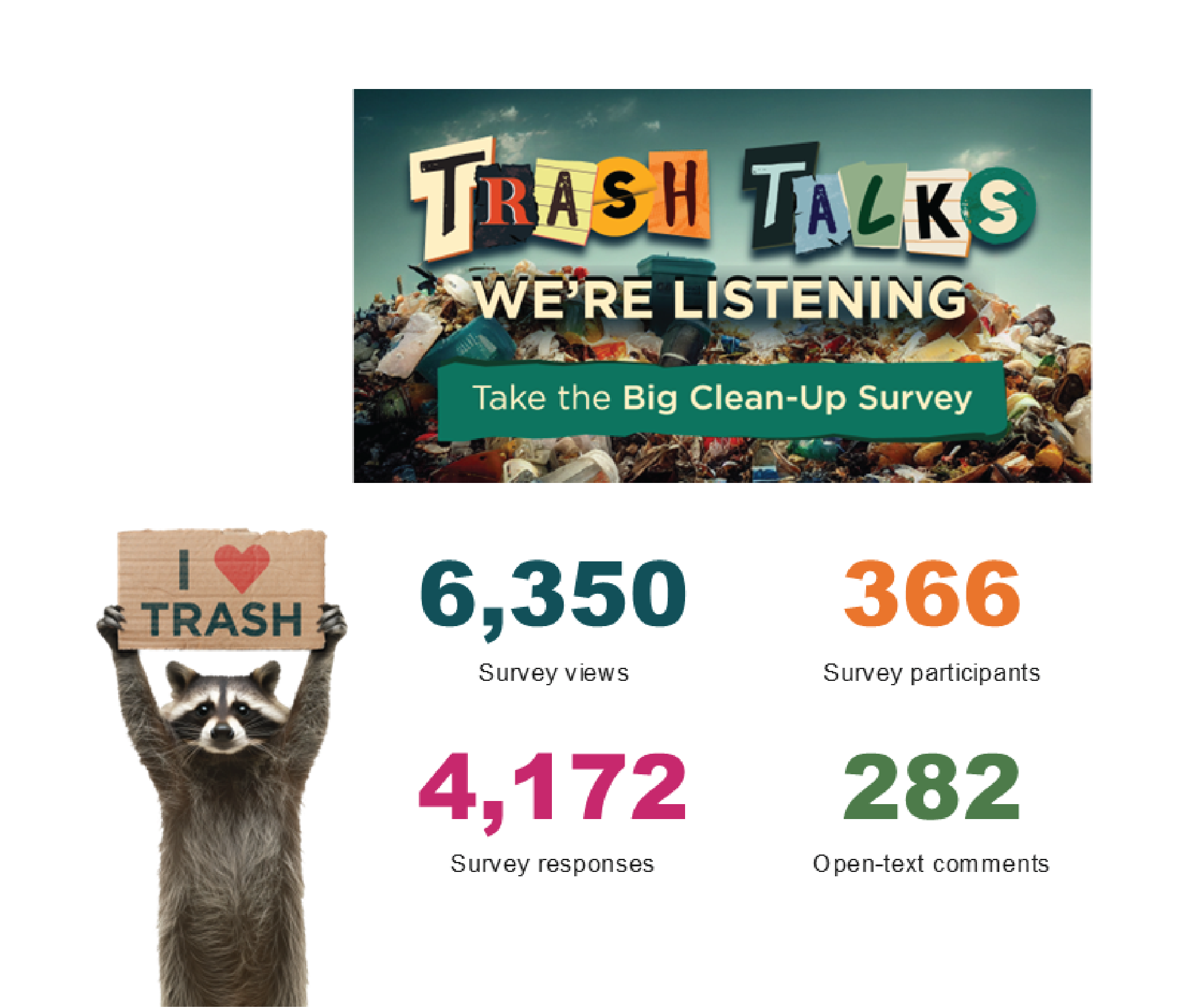
From November 2025 through May 2026, ACOG conducted Trash Talks: We’re Listening, a wide-ranging public engagement campaign that invited residents, municipal staff and ACOG Board members to tell us what works, what doesn’t and what they would like to see in the future.
366 participants provided 4,172 survey responses and 282 open-ended comments. ACOG also heard directly from 43 municipal public works staff and 29 Board members and conducted in-depth interviews with professionals representing government, private businesses, nonprofits, higher education, cooperative extension and a federal installation.
Those open-ended responses were especially valuable. They gave participants room to tell us, in their own words, about the challenges and opportunities they see in their communities.
The result is more than a collection of data. It is a clearer picture of what Central Oklahoma’s solid waste system looks like — and what communities and residents are experiencing.
WHAT WE LEARNED
1. Most Communities Manage Waste on Their Own
Only 24 of the region’s 99 municipalities — about one in four — collaborate on materials management. That can limit economies of scale and opportunities for shared services and investment. OEMA in Canadian County and MET in the Tulsa area show that formal collaboration can work in Oklahoma.
2. Access Depends on Where You Live
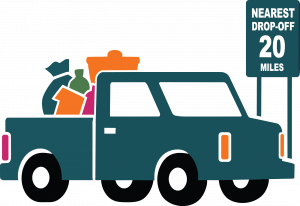
Services and infrastructure vary significantly across the region. Rural communities, outer-ring municipalities and multifamily residents face some of the greatest challenges, including long distances to drop-off locations and, in some places, no practical access to recycling.
3. Smaller Communities Face Different Challenges
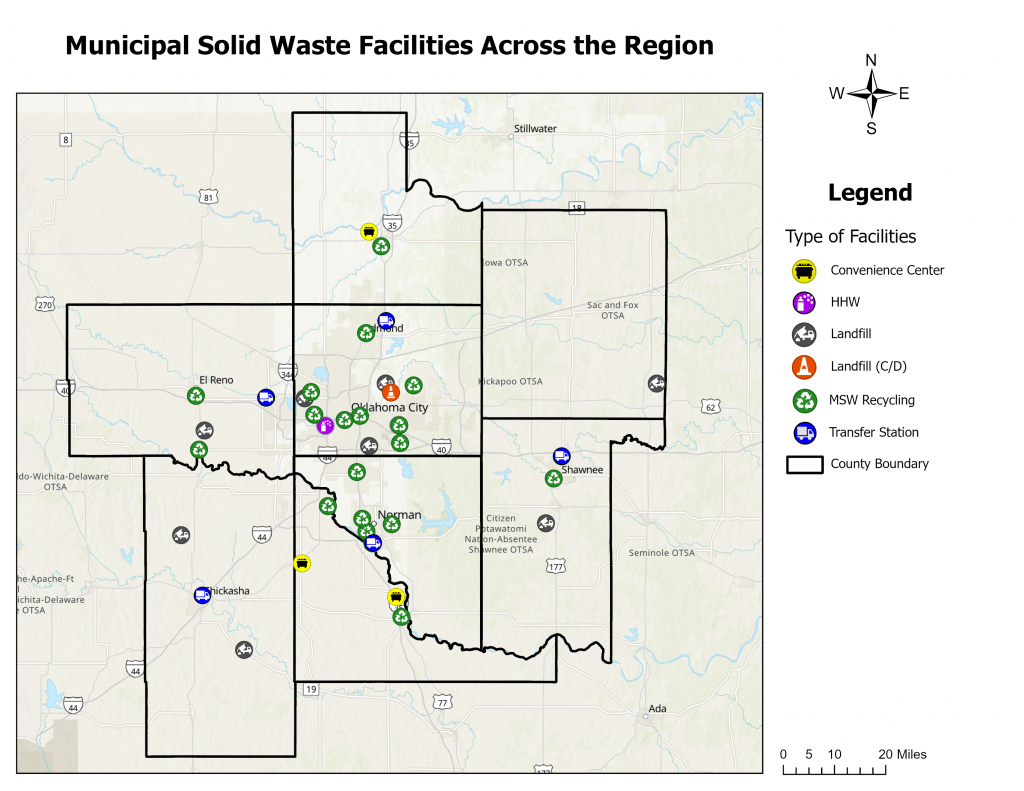
Population, geography and local fiscal capacity influence what communities can provide. The regional map reinforces the issue: infrastructure is not evenly distributed, and some of the region’s fastest-growing areas are seeing growth outpace existing capacity and accessibility.
4. Growth Is Increasing Demand
Central Oklahoma added approximately 157,000 residents over the past decade, increasing demand on existing services and infrastructure. And 82% of ACOG Board survey respondents supported updating state solid waste law or funding mechanisms to help address these needs.
THERE IS PLENTY TO BUILD ON
The assessment isn’t only about gaps.
Central Oklahoma already has successful programs, businesses and partnerships that can provide building blocks for future regional efforts.
Two DEQ-permitted composting operations — Bergen Enterprises and Prairie Dirt Solutions — divert approximately 170,000 cubic yards of organic material annually.
ACOG’s USDA-funded community composting pilot has diverted 34 tons of food waste through a network of 20 drop-off sites developed with Fertile Ground Cooperative.
The City of Norman has achieved an 88% recycling participation rate, while also offering year-round household hazardous waste and e-waste drop-off, a swap shop and a free compost program.
These examples demonstrate that Central Oklahoma does not have to start from scratch.
YESTERDAY’S ELECTRONICS COULD BECOME TOMORROW’S TECHNOLOGY
One opportunity identified through Phase I is electronic waste, or e-waste.
Old phones, computers and other electronics contain valuable metals and materials used in semiconductors, computer chips and other technology. Recovering those materials keeps them in the supply chain instead of sending them to landfills.
Yet only 9% of survey respondents said they regularly recycle electronics, and only 12% regularly recycle batteries.
At the same time, 52% of Board respondents selected a regional e-waste pilot as a priority.
Some communities are already demonstrating potential models. Norman holds biannual drive-through e-waste recycling events, while Edmond residents can arrange doorstep collection of household hazardous waste and electronics through a partnership with Republic Services.
As Oklahoma expands its role in advanced manufacturing, recovering more usable materials from yesterday’s technology could become an increasingly valuable piece of the regional materials-management picture.
9% REGULARLY RECYCLE ELECTRONICS
12% REGULARLY RECYCLE BATTERIES
52% of Board Respondents Selected a Regional E-Waste Pilot as a Priority.
WHAT COMES NEXT?
Phase I gives Central Oklahoma a common starting point. The next step is to use these findings to inform development of a regional materials management plan involving cities, counties, residents, DEQ, private-sector partners and nonprofit organizations.
ACOG is currently working with DEQ on next steps and seeking funding to continue this work.
As those discussions develop, ACOG will continue to keep our member governments and regional partners informed.
Contact Community & Economic Development Staff
Association of Central Oklahoma Governments
(405) 234-2264
Office Address
4205 N. Lincoln Blvd.
Oklahoma City, OK 73105
8:30 AM – 5:00 PM | M-F
Contact Us
Speak Up Central OK
Civil Rights-Title VI
Accessibility Statement
Privacy Policy