
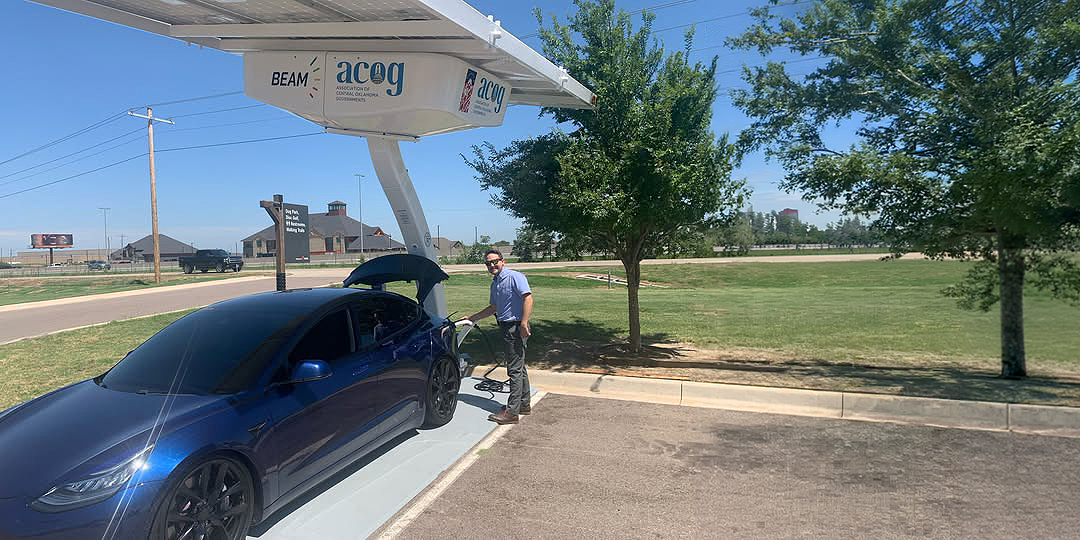
The City of Norman installed three BEAM solar-powered EV charging stations with grant funding secured through its partnership with ACOG. Photo courtesy City of Norman.
AIR QUALITY SPOTLIGHT: SOLAR, CLEAN AIR, AND CENTRAL OKLAHOMA’S ECONOMIC FUTURE
Central Oklahoma is growing. Solar is one tool communities, businesses and institutions are already using to meet energy needs while protecting clean air and supporting economic growth.
Central Oklahoma is growing. Keeping the region economically competitive means finding ways to meet increasing energy needs while protecting one of the region’s important economic assets: clean air. Solar energy is one tool already being put to work by local governments, businesses, schools and community organizations across the region.
Central Oklahoma’s growth brings new residents, businesses, development and energy demand. It also increases the importance of maintaining the region’s compliance with federal air quality standards.
The Association of Central Oklahoma Governments (ACOG) Cost of NonAttainment Study estimates that violating federal air quality standards — and becoming subject to the regulatory requirements that follow — could cost the Oklahoma City metropolitan area between $9.6 billion and $15.2 billion over a 20- to 30-year period through increased compliance costs, reduced economic competitiveness and constraints on future development.
$9.6 – $15.2 BILLION
The estimated economic cost to the Oklahoma City Metropolitan Area if the region violates federal air quality standards.
That makes air quality more than a regulatory issue. It is an economic development issue.
Solar energy is one of several strategies that can help.
Unlike electricity generation that relies on combustion, photovoltaic solar systems produce electricity without direct emissions of the air pollutants that contribute to ground-level ozone formation and particulate matter pollution. The U.S. Environmental Protection Agency also has found that reducing emissions associated with fossil fuel-based electricity generation can produce public health benefits by reducing respiratory and cardiovascular illnesses and associated health care costs.
SOLAR IS ALREADY AT WORK IN CENTRAL OKLAHOMA
The solar story in Central Oklahoma is not hypothetical. Communities, businesses, schools and nonprofit organizations are already putting the technology to use.
Solarize OKC, a City of Oklahoma City community-based group-buying program developed through a public-private coalition that included ACOG, helped residents, businesses and nonprofits access discounted solar energy systems. The campaign resulted in 152 contracts and 1,472 kilowatts of new solar capacity, generating an estimated $250,800 in annual utility bill savings and avoiding approximately 2.75 million pounds of carbon dioxide emissions each year.
A similar community-based effort, the Norman Solar Initiative, launched in 2024.
The City of Norman has also installed 2.3 megawatts of solar capacity at its Water Reclamation Facility and Water Treatment Plant. Through a partnership with ACOG, Norman secured grant funding for three Beam solar-powered electric vehicle charging stations.
Norman Water Treatment Plant. Courtesy of The City of Norman.
Private-sector organizations are investing as well. Central Oklahoma businesses including Stonecloud Brewing Company, Skydance Brewing Co., Simple Modern, Pella Windows & Doors and John Vance Ford have installed solar to help power their operations.
Solar has also reached schools and community-serving organizations. Norman Public Schools, Putnam City Schools and the Regional Food Bank of Oklahoma have installed rooftop solar in partnership with Oklahoma City-based Brightwell.
Solar installation on the roof of Norman North High School, courtesy of Brightwell.
Together, these projects demonstrate that solar can serve a wide range of users — from municipal infrastructure and schools to manufacturers, retailers, breweries and nonprofit organizations.
OKLAHOMA’S ENERGY MIX IS CHANGING
Solar remains a relatively small portion of Oklahoma’s electricity generation, but its growth has accelerated.
According to the U.S. Energy Information Administration, renewable resources accounted for 43% of Oklahoma’s in-state electricity generation in 2024, more than double the approximately 20% recorded a decade earlier. Wind accounted for approximately 94% of the state’s renewable generation.
Solar represented only 0.6% of Oklahoma’s total electricity generation, but solar generation in the state grew by nearly 500% between 2020 and 2024.
Oklahoma currently has 15 utility-scale solar facilities with approximately 274 megawatts of combined generating capacity, with another 1,143 megawatts of utility-scale capacity expected to come online by the end of 2026.
Oklahoma also ranks sixth nationally for solar potential.
Those trends suggest that solar is likely to play a growing role in the state’s energy portfolio — particularly as communities and businesses look for additional ways to diversify energy resources, manage long-term costs and meet growing electricity demand.
ACOG’S ROLE
ACOG works with local governments and regional partners to make solar deployment easier and to provide communities with information they can use when evaluating solar opportunities.
ACOG has earned a SolSmart Silver designation through the U.S. Department of Energy-supported SolSmart program. The designation recognizes communities and organizations that implement nationally recognized practices designed to reduce unnecessary barriers to solar development.
The City of Oklahoma City has maintained a SolSmart Bronze designation since 2017 and provides another local example of how solar-friendly practices can be incorporated into community planning.
ACOG also maintains a Solar Resources webpage with information about solar development, available programs and technical assistance for local governments, businesses and residents.
These efforts support several of ACOG’s broader regional planning initiatives, including the Comprehensive Economic Development Strategy, the Central Oklahoma Regional Air Quality Plan and the Red Dirt Resiliency Climate Action Plan.
CLEAN AIR IS AN ECONOMIC ASSET
Expanding solar energy will not, by itself, determine Central Oklahoma’s future air quality. But it is one practical component of a broader regional strategy to reduce emissions, diversify energy resources, strengthen resilience and support continued economic growth.
For Central Oklahoma, the stakes are significant.
As ACOG Executive Director Mark W. Sweeney, AICP noted in discussing the Cost of Nonattainment Study:
“Clean air is essential to the quality of life for all Central Oklahomans, and the region’s air quality attainment status is an economic strength that supports prosperity, opportunity, and economic development advantages over other regions.”
Protecting that advantage will require action from many sectors. The solar investments already taking place across Central Oklahoma demonstrate what that action can look like.
LEARN MORE
Explore ACOG Solar Resources
Information and technical resources for communities, businesses and residents interested in solar energy.
Read the Cost of Nonattainment Study
Learn more about the potential economic consequences of Central Oklahoma violating federal air quality standards.
Explore ACOG’s Regional Air Quality Work
Learn how ACOG and its partners are working to protect air quality while supporting continued regional growth.